

According to CloudSecureTech, “For every minute an employee can’t work, your business burns about $0.67 straight off the payroll.” Multiply that across the board, and you can see how disastrous downtime is.
However, businesses can adopt certain IT processes to mitigate the loss of productivity. One of those is having a structured IT support system.
| Bradd Konert, President of Gamma Tech Services, noted that “A structured IT support system transforms technical complexity into clear action for both teams and customers.” |
Your business tech can’t thrive in chaos. Every unresolved issue drains productivity, frustrates employees, and slows momentum, and while many assume any help desk will do, the truth is: how your IT support is structured makes all the difference.
Tiered IT support isn’t just a hierarchy; it’s a strategy. When done right, it accelerates resolution times, improves employee experience, and boosts customer satisfaction.
In this blog, you’ll learn:
- What each IT support tier actually does
- How to map real-world tasks to the right tier
- Common mistakes that sabotage support systems
- Actionable steps to build a tiered model that works
Let’s break down IT support tiers, demystify the structure, and help your business turn tech support into a smart, scalable advantage.
Break Free From Endless Ticket Backlogs Today!
Get expert guidance on setting up IT support tiers that actually resolve issues fast.
Crush Your IT Bottlenecks
What Are IT Support Tiers?
IT support tiers are structured levels of technical expertise designed to handle issues based on complexity, urgency, and specialization. Instead of treating every problem the same, a tiered system routes issues to the right people, fast.
Here’s how it works:
- Tier 1 handles basic troubleshooting and user support.
- Tier 2 tackles more complex technical issues requiring deeper knowledge.
- Tier 3 involves advanced diagnostics, system-level fixes, and vendor coordination.
For your business, this structure means:
- Faster resolution times by matching problems to the right skill level
- Predictable workflows that reduce bottlenecks and confusion
- Clear career paths for IT staff, boosting retention and expertise
- Consistent service quality for employees and customers alike
Think of it as a smart roadmap. Issues flow through the right channels, escalation is controlled, and your systems stay reliable. This isn’t just about dividing labor. It’s about building an IT support engine that prevents chaos, scales with your business, and delivers results. Next, we’ll further explain what the difference is between IT support tiers.
Tier 0: Self-Service Tools and Knowledge Resources
Tier 0 is your frontline defense against ticket overload. It includes automated resources such as knowledge bases, FAQ pages, AI chatbots, and self-service portals. These tools empower users to solve common issues without human intervention.
Examples of Tier 0 tasks:
Password resets: Users follow automated guides to regain access without submitting a ticket.
Billing inquiries: Customers view invoices and payment history independently.
Product guidance: Tutorials and troubleshooting articles reduce routine support requests.
The benefits are clear:
- Lower ticket volume frees up Tier 1 and Tier 2 agents for complex issues.
- Faster resolutions improve user satisfaction and reduce frustration.
- Scalable support that grows without adding headcount.
81% of customers try to solve their issues on their own before reaching out for help. A strong Tier 0 system transforms your support structure. It reduces repetitive tasks, improves efficiency across all tiers, and delivers instant value to users.
Tier 1: Basic Human Support
Tier 1 is the first human touchpoint in your support hierarchy. These agents handle straightforward issues that require interaction but not deep technical expertise.
Common Tier 1 responsibilities include:
- Account setup: Assisting users with new account creation and access.
- Password resets and lockouts: Stepping in when Tier 0 fails or isn’t available.
- Peripheral troubleshooting: Resolving printer, mouse, or monitor issues that disrupt workflows.
Tier 1 agents also serve as gatekeepers for escalation. When an issue exceeds their scope, they route it to Tier 2 or Tier 3, ensuring users aren’t stuck waiting for advanced support.
Why Tier 1 matters:
- Reduces bottlenecks by filtering and resolving common issues quickly.
- Improves consistency through structured training and standardized responses.
- Supports higher tiers by preventing unnecessary escalations.
A well-trained Tier 1 team boosts the performance of your entire support system.
Tier 2: Technical Troubleshooting
Tier 2 is where deeper technical expertise meets operational efficiency. These specialists handle issues that exceed Tier 1’s scope. Most times, these problems require diagnostic skill, system-level access, and product fluency.
Typical Tier 2 responsibilities include:
- Software bug fixes: Resolving recurring issues using known solutions and patches.
- Backend configurations: Ensuring systems run smoothly behind the scenes, from server settings to database tuning.
- Complex product questions: Assisting users with advanced features, integrations, or add-ons.
Tier 2 teams also play a pivotal role in documentation. Every resolved issue becomes part of a growing knowledge base that empowers Tier 1 agents and reduces future escalations.
Organizations with trained Tier 2 teams resolve more tickets without escalating to Tier 3. This keeps expert-level support focused on critical issues and makes Tier 2 a cornerstone of your IT support strategy.
Tier 3: Expert and Product Specialists
Tier 3 is your highest level of technical support. This level is reserved for rare, complex, or high-stakes issues. Experts at this level possess deep knowledge of your systems, infrastructure, and products. They often collaborate with developers, engineers, and vendors to deliver permanent solutions.
Typical Tier 3 tasks include:
- ERP system failures: Diagnosing and resolving intricate errors that impact core business functions.
- Root cause analysis: Identifying systemic issues and designing long-term fixes.
- Critical bug resolution: Working with development teams to patch vulnerabilities and improve product stability.
Tier 3’s value lies in risk reduction and reliability. They prevent prolonged downtime, guide system evolution, and inform lower tiers through structured knowledge sharing.
When Tier 3 is properly integrated, your support ecosystem becomes smarter, faster, and more resilient.
| Learn More About How You Can Set Your IT Team Up For Success How to Choose a Managed IT Services Provider Cord Cutting (Should you make this switch?) How Much Storage Should I Have For My NVR? |
Tier 4: Vendor or Third-Party Support
Tier 4 represents external expertise, often support provided by vendors or specialized providers when internal teams reach the edge of their capabilities. While not every business uses this tier daily, it becomes essential when proprietary systems or vendor-specific technologies are involved.
Common Tier 4 scenarios include:
- SaaS platform support beyond internal documentation or training
- Hardware warranties requiring manufacturer diagnostics or replacement
- Licensing and proprietary software issues that demand vendor-side resolution
Tier 4 requires tight coordination. Your internal team must track progress, manage communication, and ensure vendor actions align with business priorities. When integrated properly, Tier 4 extends your support ecosystem without disrupting service continuity.
Common Mistakes in Implementing the Tiers of IT Support
Even with the best intentions, businesses often misstep when building tiered support systems. Here are the most frequent pitfalls:
- Neglecting Tier 0 self-service: This leads to unnecessary ticket volume and delays for simple issues.
- Undertrained Tier 1 staff: Poor responses and missed escalations create bottlenecks and user frustration.
- Weak handoff protocols: Without clear escalation paths, issues bounce between tiers, wasting time and eroding trust.
The consequences?
- Wasted time across teams
- Frustrated customers who feel unheard
- Burned-out employees stuck in reactive mode
Avoid these traps by investing in:
- Structured training for each tier
- Defined escalation protocols that ensure smooth transitions
- Consistent documentation to build institutional knowledge and reduce repeat issues
Even better, outsource your helpdesk to a reliable managed services provider. When implemented correctly, tiered support becomes a scalable engine for resolution, satisfaction, and operational excellence.
How to Align Tiered IT Support With Your Business Needs
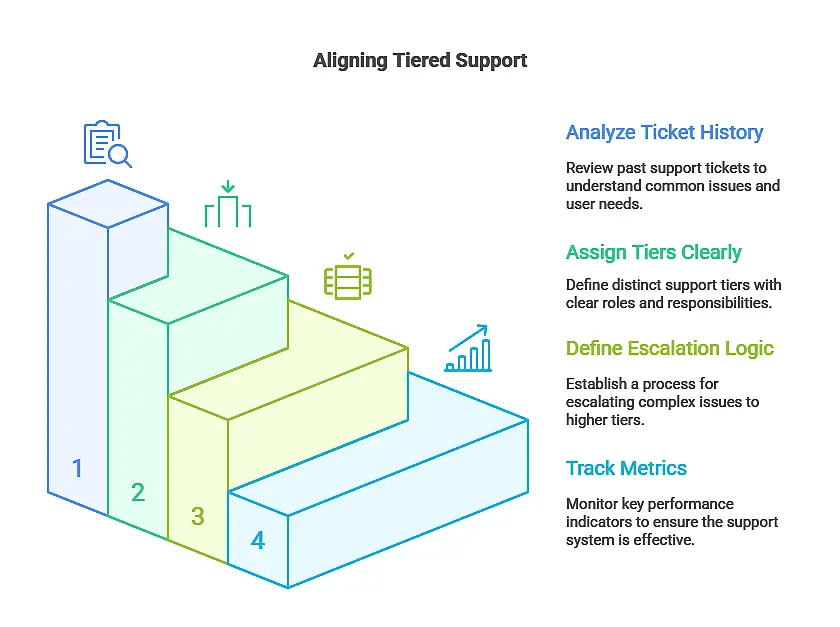
A tiered support system only delivers value when it’s tailored to your business. That means aligning each tier with the complexity of your issues, the needs of your users, and the realities of your operations.
Here’s how to do it:
- Analyze ticket history: Review past support requests to identify recurring issues and classify them by complexity.
- Assign tiers clearly: Map each issue type to a specific tier to avoid confusion and delays.
- Define escalation logic: Establish clear rules for when and how tickets move up the hierarchy.
- Track metrics: Monitor first-time resolution rates, reassignments, and time-to-escalate to measure performance and spot inefficiencies.
Proper alignment delivers measurable benefits:
- Lower support costs through efficient resource use
- Improved staff retention by reducing burnout and clarifying roles
- Consistent service reliability that boosts customer satisfaction
- Smarter resource allocation across your support structure
A Breakdown of IT Technical Support Tier Tasks
This table summarizes each tier’s scope, responsibilities, and strategic value, giving you a blueprint for building a support system that works:
| Tier | Scope | Typical Tasks | Key Benefit |
|---|---|---|---|
| Tier 0 | Self-service | FAQ navigation, password resets, and basic product guides | Reduces human ticket load |
| Tier 1 | General human support | Account setup, printer troubleshooting, and routing issues | Fast resolution of routine queries |
| Tier 2 | Technical troubleshooting | Software bugs, backend configuration, and advanced product support | Resolves moderately complex issues efficiently |
| Tier 3 | Expert specialists | ERP failures, critical bug fixes, root cause analysis | Prevents major downtime and risk |
| Tier 4 | Vendor/third-party | Hardware vendor support, SaaS platform issues, licensing | Ensures proprietary system resolution |
This breakdown helps you design a strategic support hierarchy. When each tier is clearly defined and properly staffed, your IT support becomes a driver of efficiency, reliability, and growth.
Level Up Your IT Infrastructure with Gamma Tech Services Structured IT Support Tiers
Tiered IT support is a “non-negotiable” for businesses that value speed, reliability, and customer satisfaction. A well-structured support system improves resolution times, empowers employees, and delivers consistent service across every touchpoint.
Gamma Tech Services specializes in tiered IT solutions designed for real-world complexity. With a free IT assessment and consultation, expert escalation management, and proven frameworks, we help businesses streamline support and reduce operational friction.
Our clients report:
- Faster issue resolution across all tiers
- Measurable cost savings through efficient ticket handling
- Improved system reliability and user satisfaction
| Discover Reliable IT Services Near You! | |
| Naples | Fort Myers |
Don’t let technical issues slow your momentum. Contact us today to evaluate your support structure and schedule a consultation. Start resolving IT issues faster, smarter, and without disruption!