
What is a layer of light?
A layer of light is a group of lights chosen to do a particular job in a room. One group may provide enough light to move around comfortably, another may light the counter where you prepare food, and a third may draw attention to artwork. Each group contributes something useful, and you can adjust their brightness together or separately to suit what you are doing.
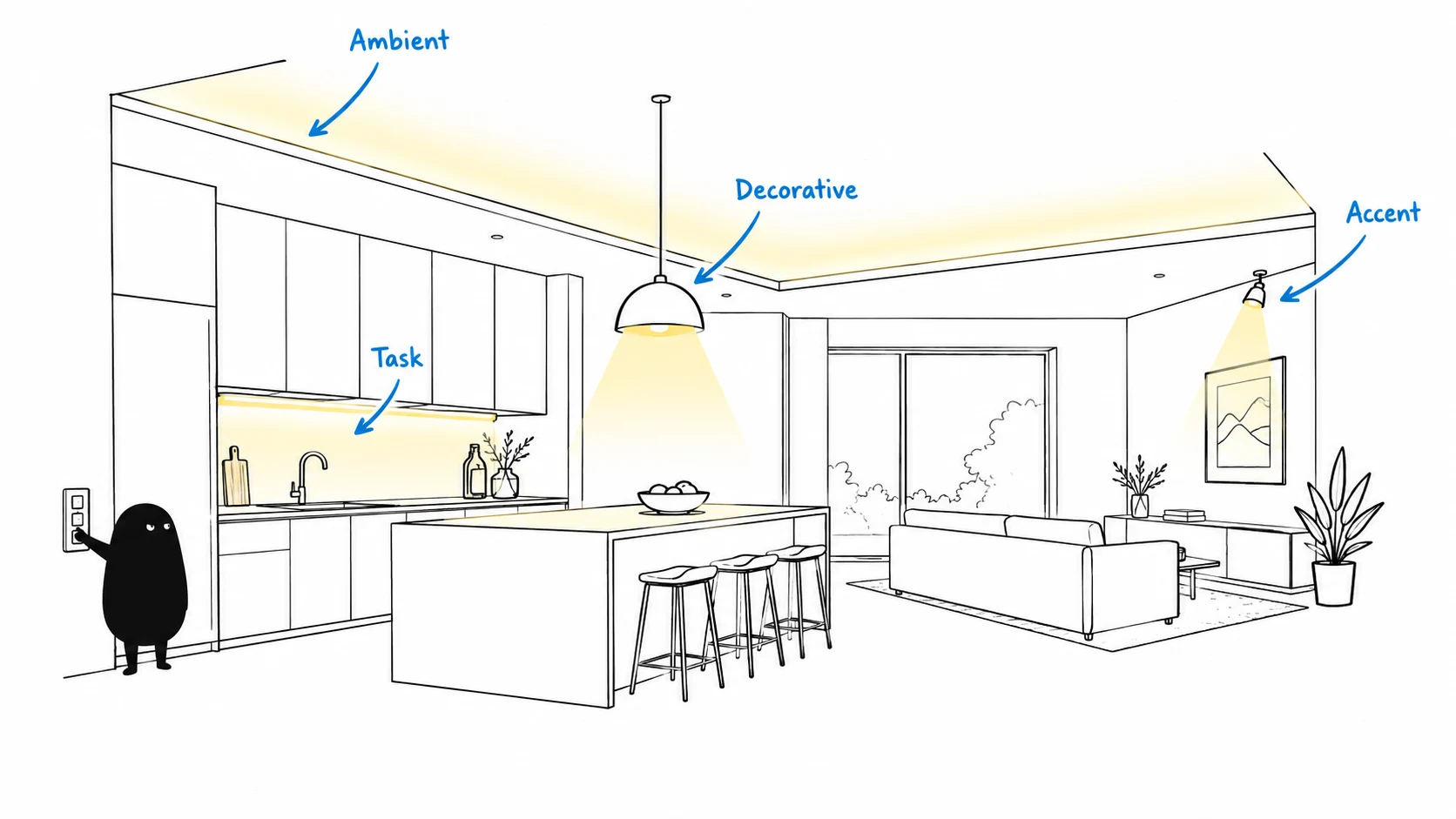
Picture a kitchen with recessed ceiling lights, lights beneath the cabinets and pendants above the island. The ceiling lights help you see across the room, the under-cabinet lights illuminate the work surface, and the pendants add character while lighting the island. Each source has a role, and some fixtures serve more than one purpose. Those roles give us four useful categories.
The four layers of light
Ambient light provides the room's general illumination. Recessed downlights and indirect cove lighting are common examples. Look at the spaces between the fixtures as well as the ceiling itself: a comfortable route across the room matters as much as a bright spot directly beneath a downlight.
Task light helps with a specific activity. Under-cabinet lighting serves a kitchen counter, a reading light serves a chair, and vanity lighting serves the person standing at the mirror. The useful question is whether the light reaches the work surface while someone is actually using it. Standing between a ceiling light and a cutting board can put your own shadow across the area you need to see.
Accent light highlights art, stone, shelving or architectural details. Decide what deserves attention, then check the result from the doorway and your usual seating position. A bright reflection in the glass over a painting can compete with the artwork itself.
Decorative light gives the fixture a visible role in the design. Chandeliers, pendants and sconces can help establish the character of a room while also contributing useful illumination. A pendant over an island may provide decorative and task light at the same time; the categories describe what the light does.
Bring the room to life
Layers of paint bring a painting to life as the artist builds up color, highlights and shadows, and layers of light bring that same sense of depth to your home. A flat wash of one color can leave a painting without much dimension, and a room lit by a single overhead source can feel similarly flat. The floor may be bright while the artwork fades into the background, the reading chair sits in shadow and the counter becomes difficult to see beneath your hands.
Adding light where it has a purpose brings those parts of the room into focus. A reading light makes the chair useful, a carefully aimed accent reveals the artwork, and under-cabinet lighting gives you a clear view of the counter. Adjusting the balance lets the room feel different during cooking, dinner and a quiet evening. Placement, aiming and brightness all contribute to the result.
Plan from the room's activities
A floor plan becomes more useful once you mark where people will sit, read, cook and move through the home. Furniture, cabinets and artwork give the lighting designer specific targets, and each target deserves a check from the position of the person using it. These examples are planning exercises you can apply to your own rooms.
- Kitchen: Mark the preparation counter, sink and island seating separately. Check counter lighting with someone standing in the normal working position, then look for reflections on the countertop and visible light sources from an island stool.
- Living room: Plan a light for the reading seat, softer general illumination for conversation and a separate highlight for a feature you enjoy. Sit facing the television to check whether a fixture or window creates a distracting reflection.
- Bathroom: Evaluate the mirror while standing at it. Light that makes the floor bright may still leave shadows across your face, so include the mirror position in the fixture discussion.
- Bedroom and hallway: Plan bedtime reading and the route to the bathroom. Review which lights you can reach from bed and how a nighttime setting can preserve visibility without lighting the entire room at daytime levels.
- Lanai and arrival: Include the approach to the door, steps and outdoor seating in the plan. Check the view outward from inside after dark, because interior reflections can affect how clearly you see through the glass.
Brightness, color and dimming are separate decisions
Brightness describes how much light you get, while color temperature describes the appearance of white light. Lower Kelvin values look warmer and higher values look cooler. A fixture's lumen rating describes its light output; the light that reaches your counter also depends on placement, beam distribution and the room's surfaces. A lighting professional can evaluate the working area directly and interpret the fixture rating in the context of the room.
Dimming reduces brightness. A standard fixed-color LED can become dimmer while keeping approximately the same white appearance. Warm dim products are designed to become warmer as they dim, and tunable white products allow the white appearance to change within their supported range. The fixture, driver and control system determine which adjustments are available.
Lutron's Lumaris programming documentation shows how compatible tape lighting can participate in time-based settings in RadioRA 3 and HomeWorks QSX. Reading those examples can help you describe the effect you want, but the design still needs to confirm the exact equipment and supported features. A regular dimmer alone will not add color tuning to a fixed-color light.
Use scenes to make the layers easy to live with
A scene recalls a group of light settings together. You can choose Cooking or Dinner with one control, and the planned layers respond together. Lutron's RadioRA 3 overview explains the control approach; Gamma also has a guide to panelized, wireless and digital lighting control for comparing the underlying systems.
The worksheet below gives activity goals for each lighting scene. Actual settings need to be tested in the finished room because fixtures, finishes and personal preferences change the result.
| Scene | Layers to emphasize | Check in the room |
|---|---|---|
| Cooking | Clear task light on counters, with enough ambient light for movement | Can you see the preparation area clearly with someone standing at the counter? |
| Dinner | Comfortable light at the table, softer general light and selected accents | Can you see faces and food comfortably without a bright source in your eyes? |
| Goodnight | Low-level route lighting where needed, with other layers reduced or off | Can you find the hallway and bathroom controls and see changes in floor level? |
Simple engraved keypad labels make the scenes easier for family members and guests to use. A reliable plan also includes a clear way to raise the lights for cleaning or change a scene that no longer suits your routine. Discuss the normal behavior after a power interruption during commissioning.
Daylight belongs in the lighting plan
A room's daytime lighting changes as the sun moves, and windows can introduce glare even while they provide useful illumination. Review where the sun falls during the times you use the room, then coordinate shades with the electric lighting. Lutron's guide to layered window treatments explains how shades can manage daylight within the ambient layer.
Review the room with shades open and closed, then repeat the check after dark. A lighting scene that feels comfortable at noon may need different settings in the evening. The goal is to make the usual transitions easy without requiring constant adjustments.
Plan during construction and test before installation
Construction planning gives your team the opportunity to coordinate fixture locations, ceiling details, coves, cabinetry and keypad positions before drywall goes up. Decorative fixtures should be selected early enough to confirm their dimensions and control requirements. Drivers and other serviceable components also need accessible locations so future maintenance has been considered.
A sample test can reveal problems that a specification sheet misses. Ask the team to demonstrate the proposed fixture, driver and dimmer together at bright, medium and low settings. Look for flicker, listen for noise and check whether the light starts and dims smoothly. Lutron's LED compatibility tool is useful for checking tested bulb and dimmer combinations; integrated fixtures also require their exact driver and control specifications to be verified.
Finish the installation with a walkthrough from the places you actually use. Sit on the sofa, stand at the mirror and walk into the room after dark. Aiming fixtures and refining scenes at that stage helps turn a sound plan into lighting that works naturally in the home.
Try a lighting exercise tonight
You can learn a great deal with the lights already in your room. This observation exercise helps you identify what to discuss with a designer and requires no electrical changes.
- Choose one room and one activity, such as reading on the sofa or preparing dinner.
- Use your normal light setting and notice the work surface, your view across the room and any reflections or shadows.
- Change one existing light at a time. Try a table lamp or under-cabinet light and observe what changes before adding another source.
- Write down the result in plain language: “The counter is clearer,” “The lamp reflects in the television,” or “The artwork disappears after sunset.”
- Repeat the check at another time of day and bring the observations to your planning meeting.
Those observations give your team a useful starting point. You can also download the one-page lighting worksheet to record room activities, glare checks and the scenes you want.
A useful brief for your lighting team
- List the activities each room needs to support in the morning, evening and late at night.
- Mark the furniture, work surfaces, art and architecture you want the lighting to serve.
- Choose decorative fixtures early and check their control requirements.
- Plan keypad locations around your usual routes through the home.
- Include exterior lighting, daylight and shades in the discussion.
- Ask for a fixture-and-control sample test, followed by a finished-room scene walkthrough.
Our Naples experience center brings cove lighting, recessed downlights and lit shelving together, giving you a place to see how the layers interact. Gamma Tech designs layered lighting and Lutron lighting control for homes in Naples, Marco Island and across Southwest Florida. Explore our lighting control and design services or arrange a visit to talk through the rooms you are planning.