



Table of Contents
Creating a business IT plan matters because your systems touch approvals, customer records, invoices, support tickets, vendor portals, and employee workflows every day. When those connections are unclear, small delays become rework across billing, service delivery, reporting, and customer handoffs.
A practical IT business strategy turns technology choices into operating decisions, so you know what to fund, who owns each platform, and how data moves between teams. A recent Gartner report suggests only 23% of CIOs rate their organization as effective at business strategy and planning.
Bradd Konert, President of Gamma Tech Services at Gamma Tech Services, notes: “Start by documenting the workflows that lose time today, then decide which systems, owners, and support rules must change to protect daily operations.”
What Is An IT Strategy In Daily Operations
An IT strategy is a documented plan for how technology supports revenue, service delivery, productivity, data security, software decisions, support expectations, and growth. It should explain how work gets done, not just which tools are installed.
Shared definitions matter before budgets, vendors, and internal ownership are assigned. As businesses move to the cloud, where worldwide public cloud spending reaches 723 billion dollars in 2025, managing licenses, storage, backups, and user access becomes a daily operating issue.
-
Business outcomes first: Connect tools to faster approvals, fewer duplicate entries, cleaner reporting, and easier ticket submission.
-
System ownership clarity: Identify who approves changes, maintains access, and receives escalation notices when key platforms fail.
-
Data and workflow alignment: Ensure CRM, accounting, project management, marketing, and industry-specific platforms pass clean information between teams.
-
Support expectations documented: Define response expectations, issue priorities, and vendor responsibilities before problems create confusion.
Specific Domain Scenario: In a construction workflow, jobsite connectivity affects field device support, project document access, and billing updates. In healthcare, role-based access touches patient scheduling, billing, and software administration, so permissions must follow actual responsibilities instead of a generic job title.
Capability planning comes next.
Infrastructure, cybersecurity, application support, data governance.
Building An IT Strategy Around Growth Decisions
Growth adds pressure. A second location, new marketing platform, larger project backlog, or tighter compliance requirement quickly exposes whether your tools and support process can scale.
-
Budget follows business priorities
Technology spend should map to hiring plans, customer commitments, operational bottlenecks, and risk reduction. Reactive purchases often hide the real issue, such as delayed approvals, aging field laptops, or recurring tickets tied to the same workflow.
-
Applications need accountable owners
When leaders ask what is an IT strategy in practical terms, the answer includes ownership. Someone must approve software, manage licenses, validate integrations, and confirm access changes when an employee changes roles.
-
Support volume exposes weak processes
Repeated tickets point to root causes, not just busy users. Review ticket history for training gaps, poor permissions, aging hardware, vendor confusion, or missing documentation, then assign the fix.
-
Security affects workflow design
Access controls, backups, device standards, and password practices must fit how people work in the office, in the field, and with customers. Otherwise, employees create workarounds that increase operational risk.
-
Reporting depends on clean inputs
Invoices, project status, sales pipeline reports, customer communications, and executive decisions depend on accurate source data. Planning around people, roles, and workflows often gives a clearer cost view than counting devices alone, which is why a per-user planning lens can make budgets easier to understand.
Those decisions need to become documented business rules that employees, managers, vendors, and support teams can follow.
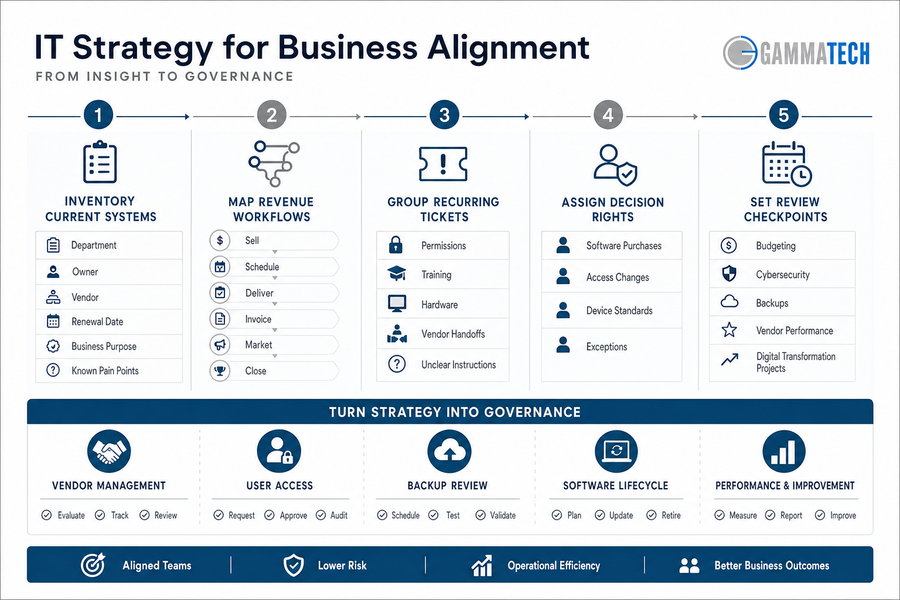
Creating An IT Strategy For Business Alignment
Organizational change is difficult because finance, operations, field teams, marketing, and vendors experience the same systems differently. A project manager cares about job files and deadlines. Finance cares about invoice accuracy. Marketing cares about campaign data and lead handoffs.
A business IT strategy must move from discussion to documented ownership, with enough flexibility to fit how work already happens. For example, 93% of executives say AI sovereignty must be factored into their 2026 business strategy, while 53% expect AI to transform business models in their industry by 2030.
-
Inventory current systems: List department, owner, vendor, renewal date, business purpose, and known pain points for each platform.
-
Map revenue workflows: Document how work is sold, scheduled, delivered, invoiced, marketed, and closed.
-
Group recurring tickets: Sort issues by root cause, such as permissions, training, hardware, vendor handoffs, or unclear instructions.
-
Assign decision rights: Define who approves software purchases, access changes, device standards, and exceptions.
-
Set review checkpoints: Review budgeting, cybersecurity, backups, vendor performance, and digital transformation projects on a set schedule.
The next step is turning those decisions into governance people can use, including vendor management, user access, backup review, and software lifecycle planning.
Build Strategy Into Daily IT
Documenting A Business IT Strategy People Can Follow
An undocumented plan fails when approvals depend on memory, vendor commitments live in email, or employees do not know where to submit requests. Details prevent delays.
Good documentation makes an IT strategy for business easier to execute because it gives managers, employees, vendors, and the IT partner the same reference point. It improves troubleshooting, timeline setting, cost estimates, and implementation steps because the service team can see the role, system, approval path, and business impact before work begins.
-
Governance calendar: Schedule periodic reviews for renewals, budgets, security reviews, backup tests, and major project status.
-
Request intake rules: Define how employees request software, new users, access changes, devices, marketing tools, or support.
-
Escalation and approval paths: Specify who approves cost, risk, customer impact, and exceptions when a request falls outside normal rules.
-
Service expectations: Clarify internal response priorities, vendor responsibilities, and what the IT partner should handle.
What this looks like in practice: A new hire should receive access to email, accounting software, CRM, job files, project tools, shared drives, and security groups before day one. Documentation organized by users and roles makes that request easier to approve, fulfill, and verify.
Clear documentation leads to better support outcomes and fewer preventable interruptions.
Turn Your IT Strategy Into Daily Action
Gamma Tech Services helps align systems, ownership, and workflows so your IT plan supports real operations, not just documentation.
Make Your IT Business Strategy Easier To Execute
A clear plan turns technology decisions into documented priorities, cleaner ownership, better support, stronger data habits, and lower operational confusion across approvals, tickets, invoices, and customer handoffs.
If you want help reviewing priorities, documenting the plan, and building an IT approach that supports how your business actually operates, contact Gamma Tech Services for IT Strategy services and support. We bring a warm, personable planning approach backed by careful troubleshooting and implementation detail, with support for small business, mid-sized business, enterprise, marketing IT, and digital transformation needs.
Our 20-year track record in the area and 99 percent customer retention rate over the past five years reflect the way we work: practical, attentive, and focused on the systems and workflows your team depends on every day. Contact us today.