



Table of Contents
Cloud systems keep expanding, users move between remote and on-site work, vendors multiply, helpdesk tickets pile up, cybersecurity approvals wait in inboxes, and budget decisions still need one coordinated plan. A practical IT strategy example should reduce reactive work for the people handling access requests, invoices, device issues, and vendor escalations every week.
At Gamma Tech Services, our planning stays close to those workflows because useful plans make decisions easier before tools are purchased. Strong IT strategy examples connect daily support realities to long-term maturity and give your team clearer control over what to approve, patch, monitor, escalate, and resolve.
Bradd Konert, President of Gamma Tech Services at Gamma Tech Services, notes: “Start by mapping who requests access, who approves spend, and who resolves tickets, because unclear ownership turns simple technology decisions into recurring operational delays.”
What An IT Strategy Plan Example Should Clarify First
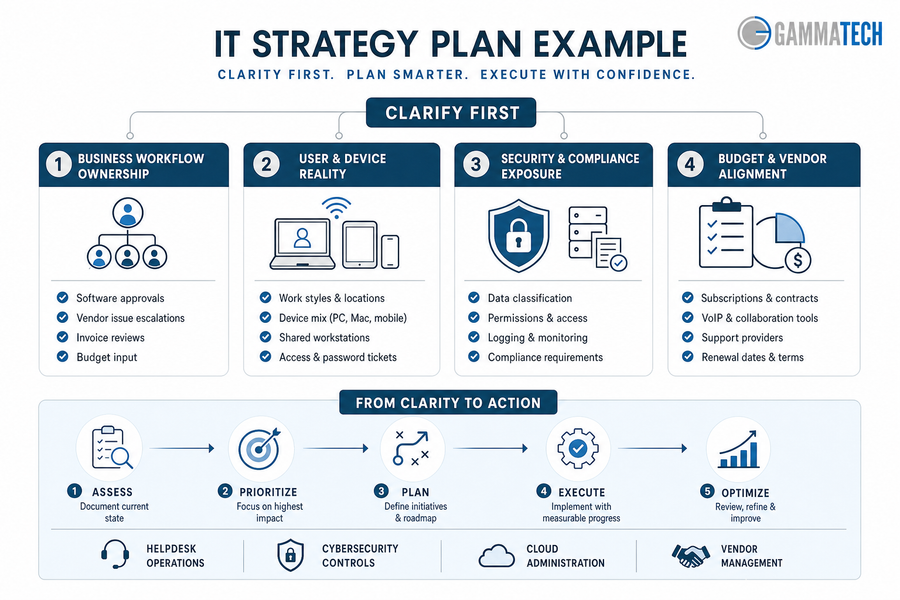
Clarity comes before tool selection, vendor changes, or budget approval. When ownership is vague, a routine software renewal becomes a finance question, a security exception waits for approval, and a helpdesk ticket stays open while staff work around the problem.
That discipline matters when technology spending faces outside pressure, including IDC research showing that over 30% of IT leaders named geopolitical impact on tech budgets as the primary risk.
-
Business workflow ownership: Document who approves software, escalates vendor issues, reviews invoices, and gives budget input when a router, firewall, or cloud renewal is due.
-
User and device reality: Review how people actually work, including shared workstations, field tablets, personal mobile devices, Mac users, and recurring access tickets.
-
Security and compliance exposure: Identify where patient data, customer records, project files, and financial reports need stronger permissions, logging, and approval steps.
-
Budget and vendor alignment: Review subscriptions, contracts, VoIP tools, support providers, cloud platforms, network equipment, and renewal dates before costs drift.
Once these basics are documented, planning moves from opinion to prioritized action. The next layer is helpdesk operations, cybersecurity controls, cloud administration, and vendor management.
An IT Strategy Roadmap Example For Operational Maturity
A roadmap turns priorities into sequenced decisions, not a long wish list. The right order depends on users, software, vendors, risk profile, and internal capacity, so you should adjust an it strategy roadmap example as conditions change.
A construction firm may need field tablets connected to project files, VoIP, cloud storage, and jobsite connectivity before a superintendent can approve change orders on schedule. If permissions, mobile device settings, and vendor applications are not documented, helpdesk tickets rise and project managers wait for file access. A clinic faces a similar issue when scheduling and billing systems need secure access for front desk staff, providers, and billing teams.
Sequencing matters because every phase affects the next. Stabilize support first, then document vendors and systems, strengthen cybersecurity controls, modernize cloud and workflow tools, and review budget and ownership with the people who approve spend and depend on uptime. We plan this way because a roadmap has to reflect real software, real vendors, and the capacity available to assess, configure, monitor, and adjust.
A Technology Strategy Example Tied To Business Impact
Technology strategy should reduce measurable friction in daily operations, not simply add platforms. A strategic IT plan connects support, security, vendors, cloud systems, and implementation work to the moments where staff lose time, customer response slows, or risk increases.
-
Fewer recurring support tickets: Document device standards, patch schedules, and helpdesk routing so a printer issue, laptop failure, or software access request reaches the right technician faster.
-
Cleaner access control decisions: Role-based access, onboarding, offboarding, and manager approvals reduce exposure when employees change roles or leave with cloud accounts still active. The practical question is simple: who approves access, who removes it, and where is that decision recorded?
-
Better vendor accountability: Vendor management ties renewals, invoices, licensing, contract terms, and support escalation to one review process instead of leaving deadlines buried in scattered emails.
-
Stronger cybersecurity readiness: Managed firewall, endpoint protection, anti-phishing, mobile device security, ransomware protection, penetration testing, and network monitoring work best when configured around real users and data.
-
More reliable cloud operations: Cloud security, backups, VoIP, network performance, and remote access directly affect uptime, call quality, and staff productivity. IBM reports that 63% of more advanced organizations report effective strategy execution, compared to 46% of less advanced organizations.
|
Operational Signal to Track |
System or Data Source |
Owner |
Practical Decision It Supports |
|---|---|---|---|
|
Repeat tickets from the same department, device model, or application within 30 days |
PSA/helpdesk platform, endpoint management logs, knowledge base search reports |
Service Desk Manager |
Update laptop standards, rewrite a setup article, or change ticket routing for payroll, CRM, or printer issues |
|
Inactive users with active Microsoft 365, VPN, or finance system access |
Identity provider, HRIS termination feed, access review exports |
IT Security Lead and HR Operations |
Trigger offboarding remediation before audit findings or unauthorized data access occur |
|
Licenses paid but unused for 60+ days |
SaaS admin consoles, renewal calendar, accounts payable invoice records |
Vendor Manager or IT Operations Lead |
Reduce renewal scope, reclaim seats, or renegotiate contract terms before the next invoice cycle |
|
Endpoints missing current protection policy or failing ransomware rollback checks |
EDR dashboard, MDM platform, vulnerability scanner |
Cybersecurity Analyst |
Prioritize patch deployment, isolate risky devices, or schedule targeted user training |
|
Cloud backup failures, VoIP jitter, or remote access latency during business hours |
Cloud backup console, network monitoring platform, firewall/VPN logs, VoIP call quality reports |
Network and Cloud Operations Team |
Adjust bandwidth, repair backup jobs, tune firewall rules, or escalate to the ISP or cloud provider |
Build Your IT Operating Plan
How An IT Strategy Template Becomes Daily Execution
Change is difficult because each department depends on different tools, vendors, approval paths, and support expectations.
IT strategy examples become useful only when the working document assigns ownership, timing, budget, risk level, and the next review date, especially as Forrester reports 86% of tech leaders expect increased budgets from the year before despite uncertainty.
-
Inventory systems, users, devices, cloud platforms, network equipment, VoIP, and critical vendor applications, including who uses them and who approves changes.
-
Map recurring tickets to root causes such as permissions, outdated devices, poor documentation, weak Wi-Fi, or vendor response delays.
-
Assign owners for patch management, access approvals, renewals, security reviews, backups, and escalation paths when systems fail or deadlines approach.
-
Review the roadmap quarterly with business leaders, finance, department heads, and IT support partners, supported by vCIO or Technical Account Manager guidance when planning accountability needs a consistent owner.
The template is not paperwork; it creates decision discipline.
Build Your IT Operating Plan
Turn your IT strategy example into practical priorities for support, security, vendors, and budgets with Gamma Tech Services.
Using Examples Of IT Strategy To Decide What Changes Next
Examples help you compare options, but the final plan must reflect actual users, devices, workflows, vendors, and risk. A useful IT strategy example also accounts for new spending pressures, such as IBM reporting AI investment has grown to about 12% of IT spend in 2024.
-
Stabilize what breaks: Prioritize outages, recurring tickets, slow networks, unresolved escalations, and poor vendor response that interrupt billing, scheduling, jobsite coordination, or customer handoffs.
-
Secure what matters: Focus on customer data, employee accounts, mobile devices, firewall rules, endpoint protection, and cloud access before adding more applications.
-
Plan what grows: Connect digital transformation, marketing IT services, enterprise IT services, and healthcare or construction software support to future staffing, sites, and capacity.
Plain language helps planning stay usable for the people approving changes, the staff opening tickets, and the vendors responsible for resolving them. Long-term IT strategy, technology implementation, cybersecurity planning, and cloud support all need clear owners, timelines, and approval paths.
Build Your Strategic IT Plan With Gamma Tech Services
A practical technology strategy example turns planning into clearer ownership, stronger security, better vendor control, and fewer operational surprises across tickets, approvals, invoices, cloud access, and support escalation.
With our 20-year track record, personable service, flexible planning, and careful follow-through, we connect IT strategy, cybersecurity, cloud, helpdesk, vendor management, and long-term roadmapping to the way work actually gets done.
If you are ready to move from scattered technology decisions to a coordinated plan, contact Gamma Tech Services to review current IT priorities and build a plan that fits the way the business actually works.